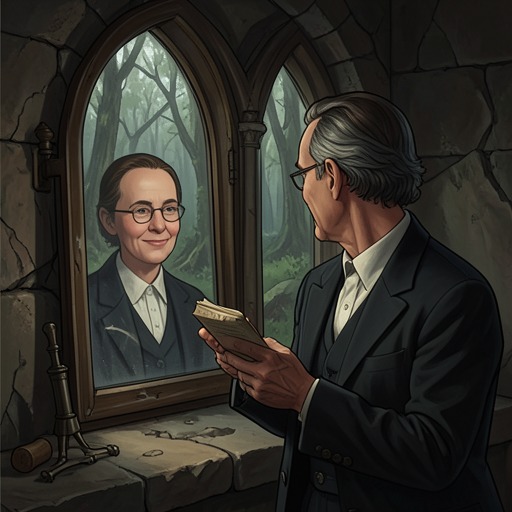
Patriarchal Order and an Imposed Mission of Atonement
Narcissus and GoldmundPatriarchal Order and an Imposed Mission of Atonement is the family and religious duty imposed on Goldmund by his father: to remain in the cloister and dedicate his life to God as expiation for the mother’s alleged wrongdoing. Its decisive significance lies in how a concealed family history becomes a vocation that Goldmund initially mistakes for his own, until Narcissus helps him recover the memory and recognize the difference between inherited obligation and personal desire.
The Father’s Account and the Cloistered Vocation
Goldmund arrives at the cloister carrying a destiny that others do not see. His father has expressed the wish that he remain there forever, and Goldmund has come to regard a life devoted to God as his intention, his father’s command, and perhaps God’s own decision. Yet an unspoken burden attaches to this plan: the suggestion that something was flawed in Goldmund’s birth and must be expiated. Abbot Daniel knows that the father wants his son to stay, but dismisses the hints about the reason, leaving the supposed need for atonement unexamined.
The father’s version of the family past gives that duty its rationale. He described Goldmund’s mother as a dancer who had been brought from poverty and shame, baptized, married, and made respectable, only to return to her former life, bring disorder to the household, and disappear. He treated her memory as forbidden and shameful, and, according to the account later recalled by Abbot Daniel, tried to suppress it in Goldmund along with any faults the boy might have inherited from her. The father believed he had succeeded: Goldmund, in his view, was willing to offer his life to God to atone for his mother’s sins.
That account is not the same as Goldmund’s own living memory. By the time the story of his mother is discussed openly, he has learned to treat it as a terrible legend and has almost forgotten the image formed in his earliest years. The contrast matters: his father’s narrative turns the mother into a source of inherited guilt, while the recovered memory makes her presence a source of warmth and love. The imposed mission rests not only on a command but on a history told in a way that has displaced Goldmund’s own experience.
Narcissus Identifies the Conflict
Narcissus questions whether Goldmund’s attraction to a life of the mind and monastic discipline fits his nature. He sees in his friend a person richly endowed in both senses and spirit, with a powerful capacity for love, yet committed to an ascetic path. Goldmund’s father supports that choice, but Narcissus cannot picture the father clearly from Goldmund’s stories. When Goldmund speaks of a trout, a butterfly, a bird, or a companion, he makes them vivid; when he speaks of his father, no comparable image emerges. Narcissus takes this absence as a reason to doubt the father’s authority over the destiny he has prescribed.
His suspicion acquires a specific basis when he tells Abbot Daniel that Goldmund may be suffering because he has forgotten his mother and the past connected with her. Narcissus admits that he knows little about her himself, but reasons from the contrast between Goldmund’s gifts and the father’s character as he has heard it described. Abbot Daniel initially finds the interpretation troublesome, then remembers the father’s own account: the mother had brought him shame and left, and he had tried to erase her memory from his son. The Abbot now sees that Narcissus has recognized something he had not, and that Goldmund’s devotional purpose may be bound to a family story the boy was never allowed to understand.
This recognition does not make Narcissus the author of a replacement destiny for Goldmund. Rather, he urges his friend to listen to the recovered image of his mother and decide what he wants. In their conversation after Goldmund’s awakening, the distinction between mother and father becomes a way to describe two inheritances: Goldmund says that his father’s image had once seemed worthy of imitation, but that it diminished when his mother reappeared in his memory. He begins to regard the life of the mind as associated with his father and hostile to the mother he has rediscovered. Narcissus goes further, suggesting that the wish for lifelong cloister life may have been the father’s invention, meant either to make Goldmund atone for his mother or to exact a form of revenge upon her.
Duty, Obedience, and Divergent Paths
The cloister is not simply a backdrop to the family conflict. It is an institution of teaching, discipline, prayer, and rank, where obligations are carried out through ordinary rules and offices. Narcissus himself is a novice and teacher, and his dispute with Father Lorenz over teaching methods shows that insight and ability do not erase hierarchy: Lorenz insists that he is the superior and Narcissus the assistant, and that the decision belongs to him. This gives the conflict between personal vocation and imposed duty a concrete institutional setting. Goldmund’s intended monastic life would have placed him within an order whose demands were real, but the question is whether the commitment expresses his own calling or fulfills his father’s design.
Narcissus’s own choice sharpens the contrast. He tells Goldmund that he is a monk who has taken vows, and that his goal remains in the cloister. He plans to ask to be released from teaching and withdraw for weeks of fasting and exercises, setting aside worldly matters. He wants their friendship to continue, but cannot lead or accompany Goldmund toward an uncertain purpose. The same discipline that may be an authentic commitment for Narcissus is therefore not automatically the right life for Goldmund. The divergence prevents monastic devotion from being treated as inherently false; the issue is the mismatch between Goldmund’s nature and a vocation chosen under paternal pressure.
When Narcissus tells Goldmund that he has been awakened, the original terms of their friendship change. Its earlier purpose, as Narcissus understands it, has been reached: Goldmund can now recognize the difference between them and seek direction beyond his friend’s example. Narcissus asks him to consult his mother’s image rather than submit to an inherited answer. Goldmund, however, cannot immediately settle the question. He acknowledges that he has spent more than three years at the cloister school and that his father has never visited, while still allowing that his father may have had a difficult life. What had once seemed as simple as letters in a textbook now carries conflicting meanings; he no longer knows whether remaining is what he desires.
The Mission’s Limits and Its Afterlife
The narrative later shows Goldmund in forms of life far removed from the cloistered role his father prescribed. He wanders, pursues love, and eventually seeks to become an artist. His apprenticeship with Master Niklaus does not follow the conventional route: guild custom calls for years of apprenticeship, normally beginning in youth, but Niklaus recognizes that Goldmund is already an adult and offers him an informal chance to learn without a contract or obligation to stay. This later path makes the contrast concrete. Goldmund’s development depends on movement, experience, and making, rather than on fulfilling the permanent monastic future imagined for him.
His refusal to be settled into an established artistic life also echoes the earlier conflict with imposed duty. Master Niklaus hopes to secure Goldmund as a partner, obtain a guild diploma for him, and preserve the workshop’s standing through his talent. Goldmund, however, feels the pull of the wandering life and resists the settled world of property and professional security. These circumstances are not identical to his father’s demand: Niklaus’s proposal arises from respect for Goldmund’s work and concern for the workshop, not from a claim that Goldmund must atone. Yet both episodes test whether another person’s plan can contain a life Goldmund experiences as his own.
On returning to the cloister, Goldmund does not simply revive his former ambition to become a monk. He asks Abbot John whether, after confession and absolution, he might be received as a lay brother, but immediately recognizes that this would change the terms of his friendship with Narcissus and place him within a role he cannot approach lightly. Instead, Narcissus encourages him to make art, and Goldmund establishes a workshop in an empty shed by the courtyard gate. He plans its tools and materials, selects timber, and works with the blacksmith’s son, Erich, to make the knives, chisels, drills, and planes he needs. The return to the cloister thus becomes an occasion for creative labor rather than a surrender to the father’s original plan.
The old language of discipline remains present, but its meaning changes. After Goldmund confesses his travels, suffering, and sins to Narcissus, the Abbot imposes a month of moderation and chastity, daily attendance at early mass, and evening prayers. Goldmund finds that these exercises bring him peace and connect the solitary demands of artistic work with a larger order. This episode distinguishes imposed atonement from a chosen practice that Goldmund can inhabit: religious discipline is not dismissed, but neither does it validate the claim that his whole life must repay his mother’s supposed sins.
The concept’s central tension is therefore between a father’s authority to name his son’s duty and the son’s difficult recovery of a self that the duty had obscured. Goldmund’s mother is first transmitted to him through accusation and shame, then encountered as a remembered presence that unsettles the story on which his vocation depended. Narcissus’s role is to expose that hidden structure without deciding Goldmund’s future for him. The eventual movement from the cloister’s prescribed atonement toward wandering, art, and a more deliberate relationship with religious practice shows the mission losing its power as an unquestioned inheritance.